Origins
The Word of Faith movement, also known as the "prosperity gospel," "positive confession," or "health and wealth gospel," emerged from a unique convergence of late 19th and early 20th-century American religious trends. Its theological roots are most closely associated with Essek William Kenyon (1867–1948.)

E.W. Kenyon: The Man Behind the Word of Faith Movement
E.W. Kenyon (1867–1948) is a pivotal figure in the history of American Christianity, widely recognized as the theological architect of the Word of Faith movement. His teachings on faith, healing, and the power of words have shaped the beliefs and practices of millions worldwide. But who was Kenyon, what did he actually teach, and why is his legacy so controversial? Here’s a comprehensive look, drawing on leading scholarship and critiques.
Who Was E.W. Kenyon?
Kenyon was born in upstate New York and came to faith in the late 19th century, a time of spiritual revival and innovation in America. He pastored churches, founded the Bethel Bible Institute, and became an early Christian radio broadcaster. Kenyon was influenced by evangelical revivalism, the Holiness movement, and the “Higher Life” or Keswick spirituality, but he also encountered the New Thought movement—a philosophy that emphasized the power of the mind and positive thinking27.
What Did Kenyon Teach?
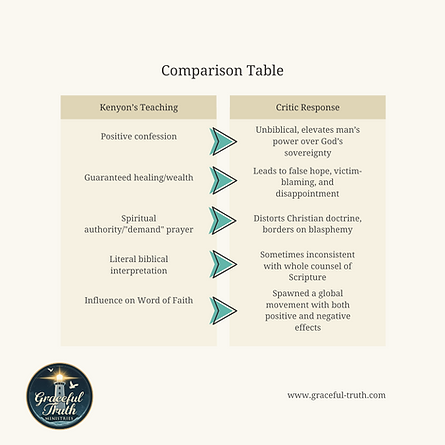
1. Positive Confession
Kenyon is best known for teaching that words have creative power. He believed that by verbally confessing God’s promises with faith, believers could “speak” health, prosperity, and victory into existence. This doctrine, called “positive confession,” became the heartbeat of the Word of Faith and prosperity gospel movements57.
2. Healing and Prosperity
Kenyon taught that Jesus’ work on the cross not only secured forgiveness of sins, but also guaranteed physical healing and financial blessing. If believers are not experiencing these, he argued, the problem lies in a lack of faith or negative confession27.
3. Spiritual Authority
He emphasized that Christians possess spiritual authority over sickness, poverty, and even demonic forces. Kenyon’s interpretation of “power of attorney” in Jesus’ name meant that believers could, in effect, “demand” God to act, rather than simply ask—a radical shift from traditional Christian prayer2.
4. Literal Biblical Interpretation
Despite accusations of heresy, Kenyon insisted on a literal reading of Scripture and rejected non-Christian metaphysics. He developed a sevenfold test for doctrine, requiring that all New Testament teaching be grounded in the entire Bible, from Genesis to Revelation16.
Was Kenyon a New Thought Teacher?
The relationship between Kenyon’s theology and New Thought is debated. Critics like D.R. McConnell and Hank Hanegraaff have accused Kenyon of importing heretical metaphysics into Christianity6. However, Robert M. Bowman, Jr. and others argue that Kenyon’s main influences were evangelical and Pentecostal, and that while he borrowed some language from New Thought, his core beliefs remained within Christian orthodoxy17. Kate Bowler notes that Kenyon’s message was an “amalgamation” of late 19th-century Christian spirituality and mind-cure philosophy, rather than a simple recycling of metaphysics2.
Kenyon’s Legacy: The Word of Faith Movement
Kenyon’s teachings were picked up and popularized by Kenneth Hagin, who sometimes copied Kenyon’s work verbatim. Through Hagin’s ministry, Bible school, and media outreach, Kenyon’s ideas spread globally, shaping the teachings of figures like Kenneth Copeland, Benny Hinn, Joyce Meyer, and Joel Osteen7.
Bowman calls Kenyon the “grandfather” of the Word of Faith movement, with Hagin as its “father.” The movement is now known for its extreme emphasis on prosperity, healing, and the power of faith-filled words7.
Critiques and Controversy
Costi W. Hinn
Costi W. Hinn, in Defining Deception and God, Greed, and the Prosperity Gospel, offers a personal and theological critique. He exposes the spiritual manipulation and exploitation that can arise from prosperity teachings, warning that they distort the biblical narrative of suffering and divine purpose and often lead to disillusionment and victim-blaming3.
Justin Peters
Justin Peters, an evangelical apologist and cerebral palsy sufferer, is a vocal critic of the Word of Faith movement. In his documentary Clouds Without Water, Peters traces many of the movement’s most troubling doctrines—such as positive confession and guaranteed healing—directly to Kenyon’s influence. Peters warns that these teachings can create false hope, undermine biblical authority, and even cross into heresy, especially when they suggest that believers can “demand” God to act or that suffering is always a sign of weak faith4.
Other Evangelical Scholars
Some, like Joe McIntyre, defend Kenyon as a misunderstood evangelical who sought to ground his teachings in Scripture and the historic Christian faith6. Bowman and others note that while Kenyon’s practical teachings overlap with New Thought, his theology was more closely aligned with the evangelical faith-cure and Pentecostal movements of his time17.